

Hidden in the green hills of Walloon Brabant, Villers Abbey is one of the most impressive and atmospheric historical sites in Belgium. As I walked among the Gothic arches and moss-covered stones, I felt carried to another time. A time where silence, prayer and simplicity shaped daily life and once home to a thriving community of Cistercian monks. The abbey is now a stunning ruin that invites you to slow down, explore and imagine the centuries of devotion that unfolded here. In this article, I’ll take you through the history, architecture and daily monastic life of Villers Abbey. I share why it’s one of the most unforgettable places I visited in May 2025 in Belgium.
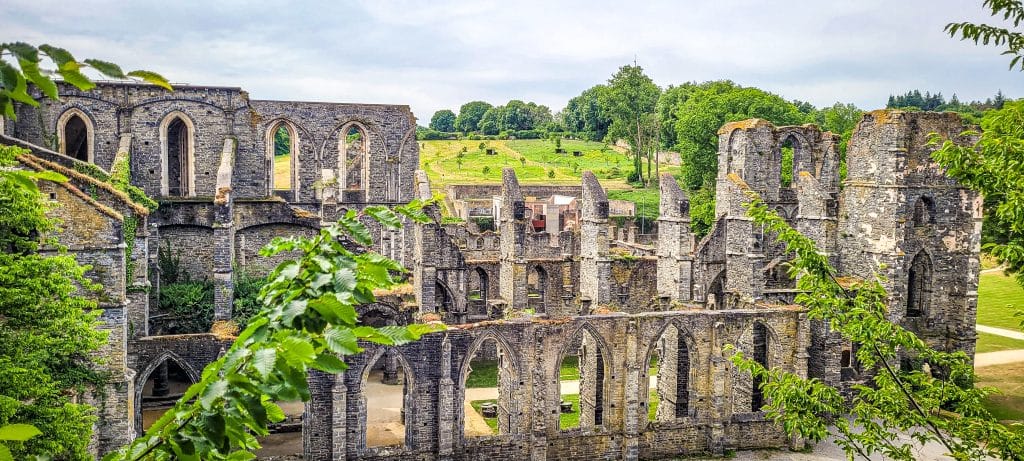
Table of Contents
History of Villers Abbey
The story of Villers Abbey began in 1146, when Cistercian monks from Clairvaux were invited to establish a new monastic settlement in Belgium. Following the strict values of simplicity, silence and manual labour, the monks chose a peaceful valley in Villers-la-Ville to build their abbey. And it was conveniently close to water, stone quarries and forests.
Golden Age: a center of faith and innovation (13th –14th century)
By the 13th century, the abbey had grown into one of the most powerful monastic complexes in Europe. Over 100 monks and 300 brothers lived here. They farmed the land, brewed beer, copied manuscripts and provided shelter to pilgrims.
Villers Abbey was completely self-sufficient and owned large tracts of farmland and forest. Its economy thrived, and its architectural style reflected this prosperity. The structures have tall pointed arches, ribbed vaults and rose windows in classic Gothic architecture style. The church was finished before 1275. It was considered one of the most beautiful in the region.


Architectural grandeur
Visitors today can walk through large stone walls, vaulted cellars and graceful cloisters that once echoed with chants. The ruins are a perfect example of Cistercian architecture. It is a balance of austerity and harmony with nature.
Highlights include:
- The grand Gothic church
- The monks’ dormitory and refectory
- The cloister garden and chapter house
- Stone wine cellars and the infirmary
Centuries of crisis and decline (16th–18th century)
Despite its power, Villers-la-Ville Abbey could not escape the political and military upheavals that rocked the Low Countries. Between the 16th and 17th centuries, it was plundered multiple times by Spanish troops, Calvinists and later the French.
The abbey experienced a brief revival in the 18th century with Baroque renovations and landscaped gardens. The abbot’s palace was rebuilt in a more refined classical style, showing a shift from medieval austerity to Enlightenment elegance.
The end of Monastic life (1796)
The French Revolution marked the end of monastic life at Villers. In 1796, the monks were expelled, the site was sold off, and much of its stonework was dismantled for building materials. The abbey was left to ruin and its vaults were open to the sky.
Romantic ruins and rediscovery (19th – 20th century)
In the 1800s, Villers Abbey became a symbol of the Romantic era. Artists and writers, including Victor Hugo, were attracted by the ivy-covered arches and crumbling facades. Railways brought curious travellers to the site, turning it into an early tourist destination.
In the 20th century, the Belgian government began preservation efforts. Today, the abbey is protected as an official heritage site and welcomes over 100,000 visitors each year.

What to see at Villers-la-Ville Abbey
A visit to Villers Abbey has much more than picturesque ruins. It’s a dive into Belgian monastical life, Gothic architecture and historic landscapes. Here are the must-see highlights:
The Grand Abbey Church
The first thing I noticed was the scale of the Gothic church. It’s breathtaking. Even without a roof, the arches still fly above you, and the rose window lets in the light just right. Built in the 13th century, this was once one of the largest Cistercian churches in Europe. Today, it’s one of the most photographed ruins in Belgium.
The Cloister
Walking through the cloister, I could imagine the monks pacing slowly, deep in prayer or thought. This area connected the dormitory, church, and refectory and was the spiritual heart of monastic life. Nearby is the Chapter House, where monks once gathered daily for readings and decisions.

The refectory and kitchen
The vaulted dining hall and stone kitchen give a glimpse into the abbey’s daily life. You can still see where meals were prepared and served in silence. It was a core part of Cistercian routine. It’s easy to picture the simplicity and rhythm of life here.
Dormitory and underground cellars
Upstairs, the dormitory was once filled with rows of beds. Down below, the wine cellars and storage rooms remain cool and dark. The abbey was completely self-sufficient, and these spaces show just how organized and practical monastic life was.
The Medicinal gardens
I loved wandering through the reconstructed medieval gardens. The medicinal garden grows traditional herbs like lavender, sage and yarrow. These plants monks once used to heal the sick. The monastic garden, with its vegetables and flowers, shows how the monks lived in harmony with the land and seasons.
The Abbey Vineyard
Yes, there’s a vineyard! Planted on a sunny hillside, the vines here reflect the abbey’s wine-making past. I found it fascinating that the monks grew Pinot Noir and Chardonnay centuries ago. Today the vineyard continues to produce small batches of wine. It’s a beautiful and unexpected part of the visit.

The Abbot’s Palace
On the edge of the site is a more elegant 18th century building. This is the Abbot’s Palace. It contrasts with the simpler medieval architecture and reflects a brief time of wealth and comfort before the abbey’s closure during the French Revolution.
Scenic walks and photo spots
Don’t skip the surrounding paths. There are several walking trails around the abbey, and they have beautiful views over the ruins, forest and vineyard. It’s one of my favourite places to take photos and just pause to enjoy the quiet.

Best time to visit
The best time to visit Villers Abbey is early in the morning on a weekday. That’s when I found it the most peaceful and less crowded. The soft morning light makes the Gothic ruins look even more magical, perfect for photography.
If mornings aren’t an option, late afternoon during the “golden hour” just before sunset is also beautiful, with warm light casting long shadows across the stone walls.
Avoid weekends and public holidays if you want to skip the crowds, especially in spring and summer when the abbey gets busy.
Spring through early autumn (April to September) is ideal for visiting because the gardens and vineyard are in full bloom, and the weather is generally pleasant for walking around the grounds.


How to get there
Train
I took a train from Brussels-South (Bruxelles-Midi) station to Villers-la-Ville station. The journey took about 50 to 60 minutes. Trains run regularly, but I checked the schedule in advance to pick a convenient time. From Villers-la-Ville station, it’s about a 15-minute walk to the abbey. The route is straightforward. Just follow the signs or use your phone’s map app.
Car
If you drive, it’s around a 40-minute drive from Brussels city centre. Take the E411 highway toward Namur and exit at Villers-la-Ville. There’s free parking at the abbey, which make it really convenient.

Highlights in Belgium
Belgium may be small, but it’s packed with incredible places just waiting to be explored! Dive into the medieval charm of Bruges, with its picturesque canals, cobblestone streets and stunning architecture. Don’t miss the vibrant city of Ghent or visit Antwerp. The city of Antwerp is the birthplace of Rubens and you can admire five monumental churches. One of these churches is the Carolus Borromeus church.
For nature lovers, the breathtaking Ardennes offer endless outdoor adventures. Visit Dinant and explore the citadel or go for hike. The Kalmthoutse Heide is a beautiful nature reserve situated between Antwerp and the Netherlands. It is perfect for a refreshing day hike. If you’re in Brussels during springtime, make sure to visit the magical Serres of Laeken. These gardens are open to the public for just six weeks each year.
History enthusiasts will find a moving experience in Ypres and the Flanders Fields. They tell the powerful story of the First World War. Get ready to discover the many wonders and heritage that make Belgium truly fascinating!


This Post Has 2 Comments
Question. I will be visiting this May (2026) and plan to include the ruins on a driving tour of the Ardennes. Based on my driving schedule, I plan to be there right when they open at 10AM. Is that considered early morning enough for good lighting for photography? When did you go? I imagine I can’t do anything earlier than that since that’s when they seem to open….
Thanks!
Hi Dani,
Arriving right at opening time at 10 AM is actually a very good choice for photography, especially in May. The light at that time of year is still relatively soft in the morning, and the sun isn’t yet high enough to create the harsh shadows you typically get around midday. You should have pleasant, angled light that brings out texture in the stonework. Especially if the sky is clear or lightly clouded. When I visited, I also went in the morning and found it ideal. There are fewer visitors and softer light compared to midday. Wishing you great weather and beautiful shots!
Adriana